Education
Building Trusted Learning Ecosystems in Moodle That Are Ready for What's Next
How Moodle Marketplace and Certified Integrations make it easier for institutions to find trusted solutions and build more inclusive learning experiences.
August 19, 2026
Discover how accessibility is shaping learning across Italy: from publishing and higher education to institutions and technology
For many years, accessibility in education was often viewed as an accommodation; something introduced when a learner required additional support. Today, that perspective is changing.
Across Europe, educational institutions are increasingly recognising that accessibility benefits everyone. Rather than being an add-on, it is becoming a fundamental element of high-quality digital learning, improving engagement, flexibility and learner autonomy while helping institutions create more inclusive environments from the outset.
Italy offers a compelling example of this evolution.
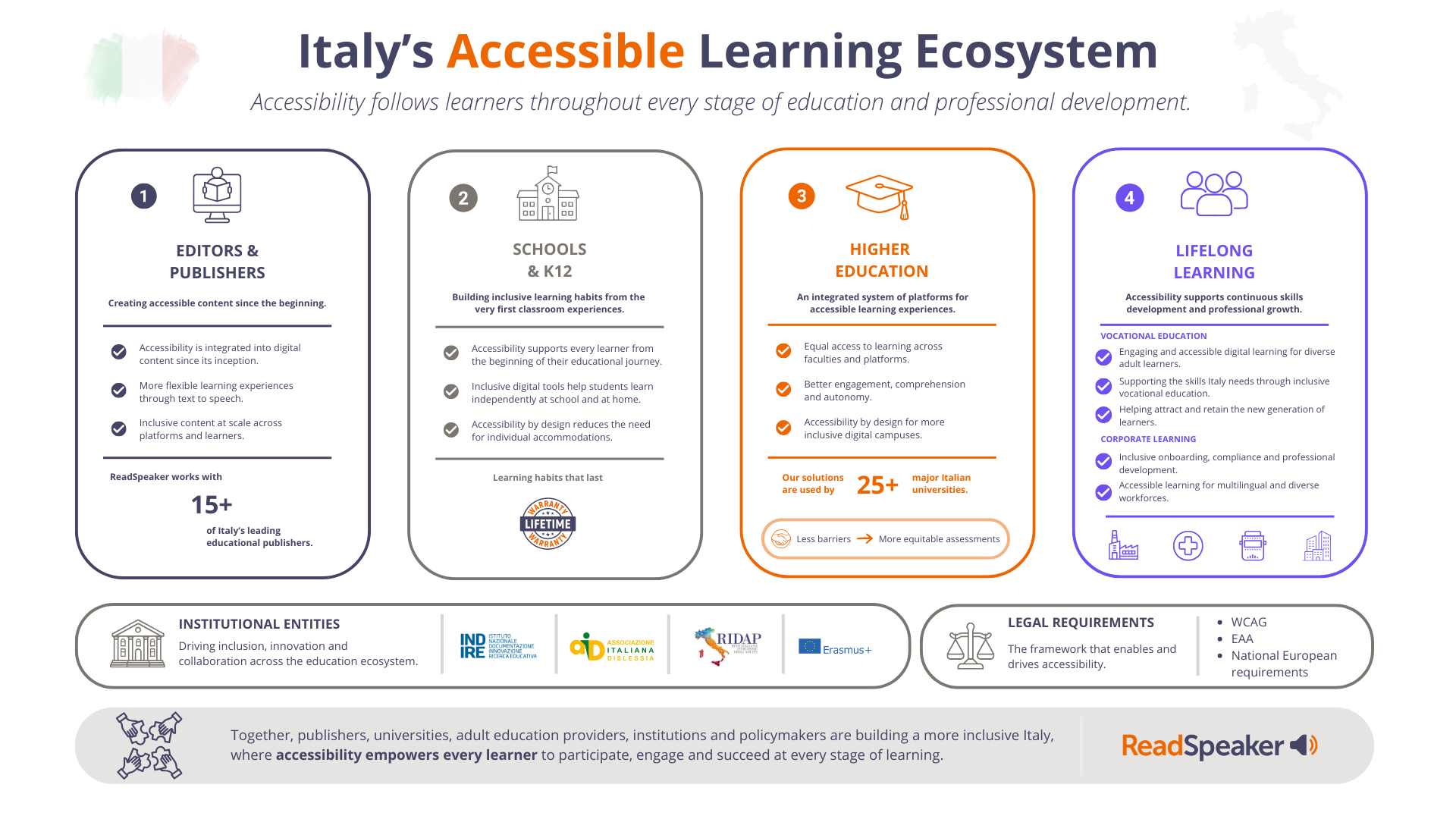
From publishers creating accessible digital content, to schools introducing inclusive learning from the earliest stages, universities building accessible digital campuses, and adult education providers supporting lifelong learning, accessibility is becoming part of the learning experience itself rather than an additional layer applied afterwards. Adult education providers, institutional organisations and an evolving regulatory framework are reinforcing this transformation, creating an ecosystem where inclusion is increasingly built into the way learning is designed, delivered and experienced.
This progress has not been driven by a single initiative or organisation. It builds on a long-standing national commitment to educational inclusion that has shaped Italy’s approach to accessibility for decades.
Italy has one of Europe’s strongest foundations for inclusive education. According to the OECD, 99.5% of students with disabilities are educated in mainstream schools, placing Italy among the few countries worldwide to achieve such high levels of educational inclusion. This commitment is supported by a robust legislative framework, including the Italian Constitution, Law 104/1992, which established rights and support for people with disabilities, and Law 170/2010, which formally recognised dyslexia and other specific learning differences while requiring schools and universities to provide appropriate educational support. More recently, European legislation, including the European Accessibility Act and the Web Accessibility Directive, has further reinforced this direction.
The result is an education ecosystem where accessibility is no longer simply about removing barriers. It is becoming an integral characteristic of modern learning, helping create more engaging, more flexible and ultimately more effective educational experiences for everyone.
 (enlarge image)
 Every accessible learning experience begins long before a student logs into a learning platform or attends their first lecture. It begins when educational content is created.
As digital learning becomes the standard across schools, universities and professional education, the decisions made by editors and publishers have a lasting impact on how learners interact with educational materials throughout their academic journey. When accessibility is considered during content creation rather than after publication, learners encounter fewer barriers, institutions spend less time implementing individual adaptations, and digital resources become more flexible for everyone.
This represents an important shift in mindset.
Instead of asking how content can be adapted for specific learners, many organisations are now asking how digital resources can be designed to be accessible from the outset. This “accessibility by design” approach aligns closely with the principles of Universal Design for Learning (UDL), creating learning experiences that accommodate different abilities, learning preferences and contexts without requiring separate versions of the same material.
For publishers, this also means viewing accessibility as an opportunity to improve the overall quality of digital learning rather than simply meeting technical requirements or responding to legislation.
Today’s learners interact with educational content in many different ways. Some prefer reading. Others benefit from listening while following highlighted text. Many switch between devices throughout the day, or study in multilingual environments where translation and audio support improve comprehension and confidence.
By embedding high-quality text to speech directly into digital publishing platforms, publishers can transform traditional digital content into multimodal learning experiences that adapt to different learning preferences without changing the content itself.
This benefits learners with dyslexia, visual impairments or reading difficulties, but it also supports multilingual students, learners studying in noisy or mobile environments, and anyone who simply retains information better through listening.
Accessibility therefore becomes less about supporting a specific group of learners and more about improving the learning experience for an increasingly diverse audience.
As accessibility expectations continue to grow across Europe, publishers that embed inclusive design into their digital products are helping establish a stronger foundation for every institution and learner that uses their content.
One of the strengths of the Italian ecosystem is that accessibility is being embraced by publishers with different audiences, educational models and areas of expertise.
ReadSpeaker works with many of Italy’s leading educational publishers and editors, helping integrate accessible reading experiences directly into their digital platforms and content.
Among them are:
Although each organisation serves different audiences and develops different types of educational content, they share a common objective: making digital learning more accessible from the moment content is created.
Together, these publishers illustrate how accessibility has become an integral part of Italy’s educational publishing landscape and an important first step in building a more inclusive learning ecosystem.
Accessibility has the greatest impact when it is embedded early in the learning journey.
Every improvement made during content creation benefits every institution that adopts the content, every educator who delivers it, and every learner who engages with it. Building accessibility upstream creates a stronger foundation for the entire education ecosystem.
The journey towards accessible learning does not begin at university; it begins much earlier.
Primary and secondary education are where learners first develop the study habits, digital skills and learning strategies that will accompany them throughout their educational journey. When accessibility is introduced at this stage, it becomes part of everyday learning rather than a specialist support used only when difficulties arise.
Italy has long been recognised for its commitment to inclusive education. Schools support a growing number of pupils with Specific Learning Disorders (DSA), while legislation ensures that learners have access to appropriate compensatory tools. Traditionally, however, these supports often relied on individual adaptations such as separate devices, separate resources or separate arrangements that could unintentionally highlight differences between learners.
Digital accessibility offers a different approach.
When text to speech and other accessibility features are embedded directly into the digital textbooks and learning platforms already used by the entire class, every learner can benefit from the same tools. Accessibility becomes a natural part of the learning experience rather than something reserved for a small group of students.
Embedding accessibility into everyday classroom practice benefits students, teachers and families alike.
Learners can listen to digital content while following synchronised text highlighting, revisit challenging passages at their own pace and continue learning at home using exactly the same digital tools they used in the classroom. This creates greater continuity between school and independent study while helping learners develop confidence and autonomy from an early age.
For teachers, integrated accessibility reduces the need to prepare multiple versions of the same materials and supports a more inclusive classroom where diverse learning preferences can be accommodated without adding unnecessary complexity.
Schools also face practical challenges, from mixed device environments to varying levels of internet access. Browser-based accessibility tools that work across different devices and operating systems, together with offline reading capabilities, help ensure that digital inclusion is not limited by technology or infrastructure.
Across Italy, schools increasingly benefit from the accessible digital content created by leading educational publishers and delivered through the platforms they already use every day.
By embedding accessibility into familiar digital learning environments, ReadSpeaker helps ensure that inclusive learning begins from a learner’s very first educational experiences, creating a foundation that supports students throughout the rest of their academic journey.
Across Italy, schools increasingly benefit from the accessible digital content created by leading educational publishers and delivered through the platforms they already use every day.
This ecosystem is also strengthened through collaboration with organisations such as the Associazione Italiana Dislessia (AID), which has played a significant role in raising awareness of dyslexia and promoting more inclusive educational practices across the country. Together, technology providers, publishers and organisations like AID are helping schools move from individual accommodations towards accessibility by design.
By embedding accessibility into familiar digital learning environments, ReadSpeaker helps ensure that inclusive learning begins from a learner’s very first educational experiences, creating a foundation that supports students throughout the rest of their academic journey.
Accessibility introduced in primary education is not a service delivered to a few learners: it is a learning habit that can follow an entire class for years to come.
When accessibility is embedded into everyday classroom experiences, students develop the confidence and independence to learn in ways that continue to benefit them throughout school, higher education and lifelong learning.
If publishers provide the foundation for accessible learning, universities are where that accessibility comes to life.
Higher education has undergone an extraordinary digital transformation over the past decade. Students now move seamlessly between learning management systems, virtual learning environments, digital libraries, assessment platforms, collaboration tools and institutional portals throughout a typical day.
For universities, accessibility is therefore no longer about making individual documents accessible, it is about creating an integrated digital ecosystem where every platform contributes to an inclusive student experience.
This is particularly important because today’s university population is more diverse than ever. Students arrive with different educational backgrounds, languages, learning preferences and accessibility requirements. They also expect digital experiences that are intuitive, flexible and available whenever and wherever they choose to learn.
The institutions that succeed are increasingly those that design accessibility into the digital campus itself rather than treating it as a separate service.
A modern university is built on interconnected technologies. Learning management systems bring together course content, communication and collaboration. Digital repositories provide access to learning materials. Assessment platforms evaluate progress. Student portals connect academic and administrative services.
For students, these systems should feel like a single learning environment.
For administrators and learning technology teams, however, they represent a complex ecosystem of platforms that must work together while remaining secure, scalable and easy to manage. This is where embedded accessibility becomes particularly valuable.
Rather than asking students to use separate assistive technologies or request individual accommodations, universities can integrate accessibility directly into the platforms they already use. This allows students to access reading support naturally within their existing learning workflow, reducing friction while promoting greater independence and learner autonomy.
Equally important is the institutional perspective. Solutions that integrate smoothly with existing LMSs and digital platforms minimise implementation effort, reduce administrative overhead and allow accessibility to be deployed consistently across faculties, departments and programmes. As a result, universities can focus less on managing accessibility and more on improving the overall student experience.
Accessibility becomes part of the digital infrastructure rather than another platform to administer.
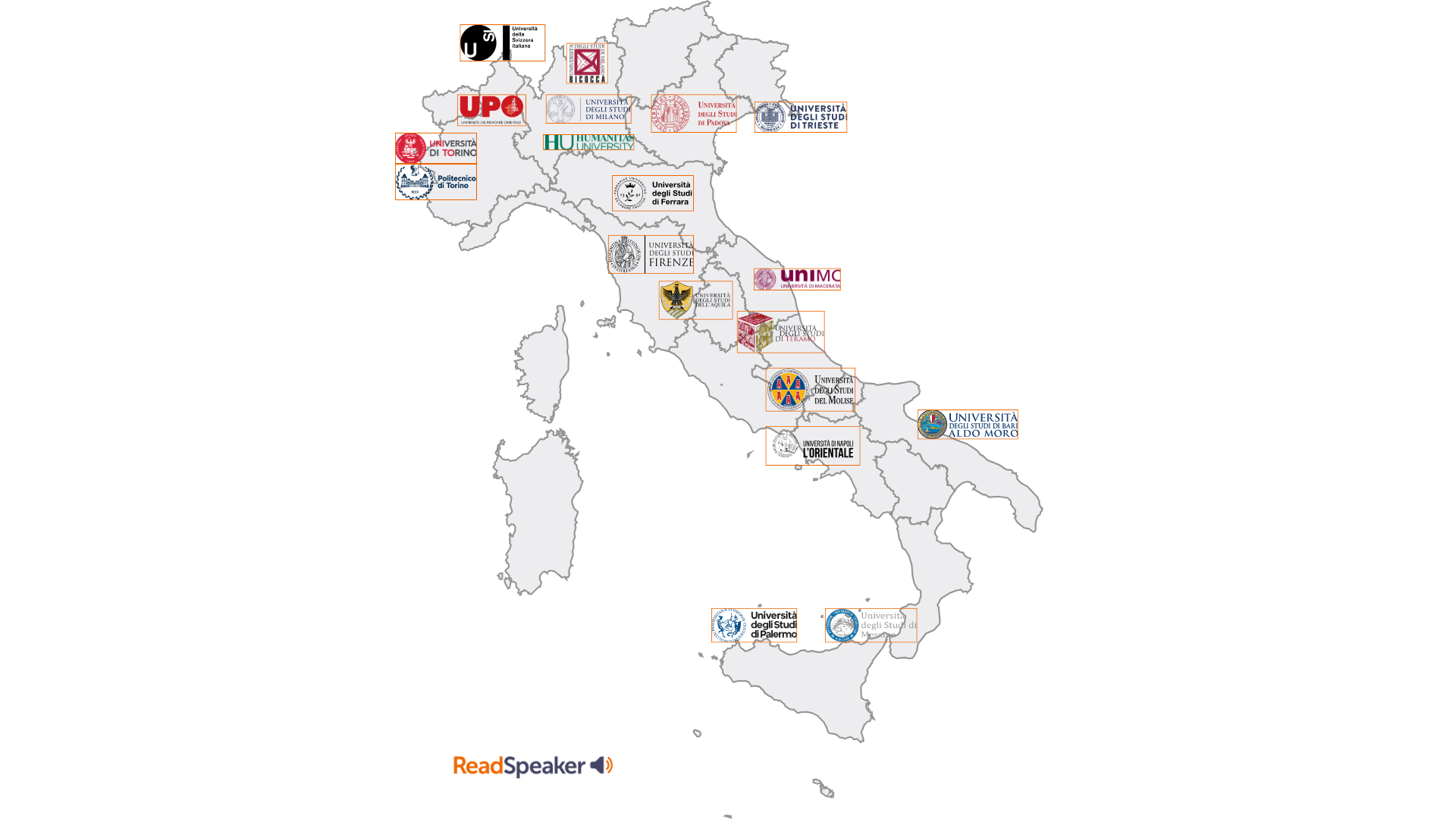
Italy’s higher education sector demonstrates how accessibility can scale when it is embedded across a diverse university landscape.
Italy’s higher education sector demonstrates how accessibility can scale when it is embedded across a diverse university landscape.
Across the country, universities have continued to strengthen their commitment to inclusion. Today, almost every Italian university operates dedicated disability and inclusion offices, while many have invested in accessible learning platforms, digital libraries, captioning services and assistive technologies to better support increasingly diverse student populations.
At the same time, perceptions of accessibility are evolving. Technologies such as text to speech are no longer viewed solely as accommodations for students with disabilities. They are increasingly recognised as tools that benefit multilingual learners, adult students, learners balancing study with work or family commitments, and anyone who prefers to learn through a combination of reading and listening.
ReadSpeaker supports universities across Italy by integrating accessible reading experiences into their existing digital learning ecosystems, helping institutions extend these inclusive practices across learning management systems, digital content and assessment platforms while creating more flexible learning experiences for all students.
Examples include:
Together, these institutions represent a broad cross-section of Italy’s higher education ecosystem, illustrating how accessibility can be implemented across different universities, regions and digital infrastructures while supporting a common goal: ensuring that every student can access, engage with and succeed in higher education.
 (enlarge image)
 Learning and assessment should provide a consistent experience. If students can access course materials independently but encounter barriers during an assessment, the learning journey becomes fragmented. Accessibility should therefore extend beyond teaching and into the way knowledge is evaluated.
This is particularly important as digital assessment becomes more widely adopted across higher education. Institutions are increasingly looking for ways to ensure that students demonstrate what they know, not how well they can navigate inaccessible digital environments.
Embedding accessibility directly into assessment platforms helps create fairer, more inclusive evaluation experiences while reducing reliance on individual accommodations. It also supports a shift towards accessibility by design, aligning with Universal Design for Learning (UDL) principles and enabling institutions to deliver assessments that work better for a broader range of learners.
The benefits extend to both students and institutions:
An accessible university is more than an accessible LMS.
Today’s students move between learning platforms, digital content, assessment systems and administrative services every day. True accessibility comes from creating a connected digital ecosystem where every part of the student experience works together.
Education does not end with graduation.
As industries evolve, technologies advance and workforce demands continue to change, learning has become a continuous process that extends throughout professional life. Lifelong learning is now recognised as a key driver of employability, social inclusion and economic resilience, helping people develop new skills, adapt to changing careers and remain active in an increasingly digital society.
For Italy, this challenge is particularly significant. Like many European countries, it faces a growing skills gap as experienced workers retire and employers struggle to recruit people with the technical and professional skills needed to support future growth. At the same time, adult learners expect flexible, engaging and accessible digital learning experiences that fit around work, family and everyday life.
Accessibility therefore plays an important role in making lifelong learning genuinely available to everyone and not only by removing barriers, but by creating learning environments that encourage participation, confidence and long-term engagement.
Within Italy’s lifelong learning ecosystem, vocational education plays a particularly important role.
Centri Provinciali per l’Istruzione degli Adulti (CPIAs) support adults returning to education, learners developing new professional skills and individuals seeking better employment opportunities. They also contribute to addressing one of Italy’s most pressing workforce challenges: attracting and preparing a new generation of skilled professionals.
CPIAs also play an important role for foreign adult learners, providing literacy and Italian-language learning pathways and supporting their participation in the Italian education and training system.
For vocational providers, accessibility is closely linked to learner engagement. Digital learning experiences that are flexible, intuitive and easy to access help learners remain engaged throughout their programmes while supporting the diverse educational backgrounds and learning needs commonly found in adult education.
By embedding accessible reading support directly into digital learning environments, institutions can offer learners greater independence when engaging with technical content, vocational materials and professional training resources.
This contributes to a broader objective: making vocational education more inclusive while helping learners develop the skills needed by today’s labour market.
ReadSpeaker works with numerous CPIAs (Centri Provinciali per l’Istruzione degli Adulti) across Italy, supporting accessible digital learning experiences for adult learners returning to education, developing new professional skills or improving their language proficiency.
A particularly significant initiative is the collaboration with RIDAP (opens in a new tab), the national network connecting more than 150 CPIAs across the country. Through this partnership, an initial group of CPIAs is introducing accessible digital learning tools to support distance learning, helping adult learners, including migrants, foreign-language learners and socially disadvantaged groups, access educational opportunities more independently.
These collaborations demonstrate how accessibility can strengthen learner engagement, improve participation and support lifelong learning while contributing to Italy’s broader response to skills development, workforce inclusion and social participation.
The need for accessible learning does not disappear once people enter the workplace.
Organisations increasingly invest in onboarding, compliance training, leadership development and continuous professional learning to help employees adapt to new technologies, regulations and ways of working. As workplace learning becomes more digital, accessibility becomes equally important.
An inclusive learning environment benefits every employee, but it is particularly valuable for individuals whose support needs may not be immediately visible.
Many organisations are placing greater emphasis on attracting and retaining neurodiverse talent, recognising the unique perspectives and capabilities these individuals bring to the workplace. Yet many employees choose not to disclose their condition or request additional support.
Research in the UK, for example, has shown that around 60% of neurodivergent employees do not disclose their condition at work, often because they fear stigma or believe it may affect career progression. When learning and training environments rely solely on traditional reading experiences, these employees may encounter unnecessary barriers without employers ever recognising that support is needed.
Embedding accessibility directly into workplace learning helps address this challenge by making training more flexible for everyone, regardless of whether employees identify as neurodivergent or request formal accommodations.
This universal approach benefits the entire workforce.
Accessible digital learning supports more effective onboarding, improves engagement with mandatory training and professional development, and helps organisations create learning environments where every employee has the opportunity to succeed.
Rather than designing learning for specific groups, organisations are increasingly designing learning that works better for everyone.
Accessibility should not end when formal education does.
Lifelong learning is becoming essential for economic growth, workforce resilience and individual career development. By embedding accessibility across vocational education and workplace learning, organisations help ensure that inclusion continues long after students leave university.
No education ecosystem develops in isolation. Alongside publishers, universities and adult education providers, institutional organisations play an essential role in advancing accessibility across the education landscape. They help connect research, policy, innovation and educational practice, ensuring that accessibility is considered not only within individual institutions but across the wider system.
These organisations create opportunities for collaboration, encourage the adoption of inclusive practices and help translate accessibility from individual initiatives into long-term educational strategies.
Their influence extends beyond individual learners or institutions, contributing to a culture where accessibility becomes a shared responsibility across the entire ecosystem.
Institutional organisations also play an important role in bridging the gap between accessibility policy and day-to-day educational practice.
By working closely with educators, universities, publishers and technology providers, they help promote approaches that are practical, scalable and aligned with the evolving needs of learners.
This collaborative model is one of the reasons Italy’s accessibility ecosystem continues to mature. Progress is not driven by technology alone, but by partnerships that bring together expertise from across education, research and inclusion.
We are proud to collaborate with organisations that are helping shape a more inclusive education ecosystem across Italy.
Among them are:
Although each organisation has a different mission, together they demonstrate how collaboration between institutions, educators and technology providers strengthens accessibility across the entire education ecosystem.
Strong accessibility ecosystems are built through collaboration, not individual initiatives.
Publishers, universities, vocational providers, institutions and technology partners each contribute different expertise, but together they create learning environments that are more inclusive, more connected and better prepared for the future.
 (enlarge image)
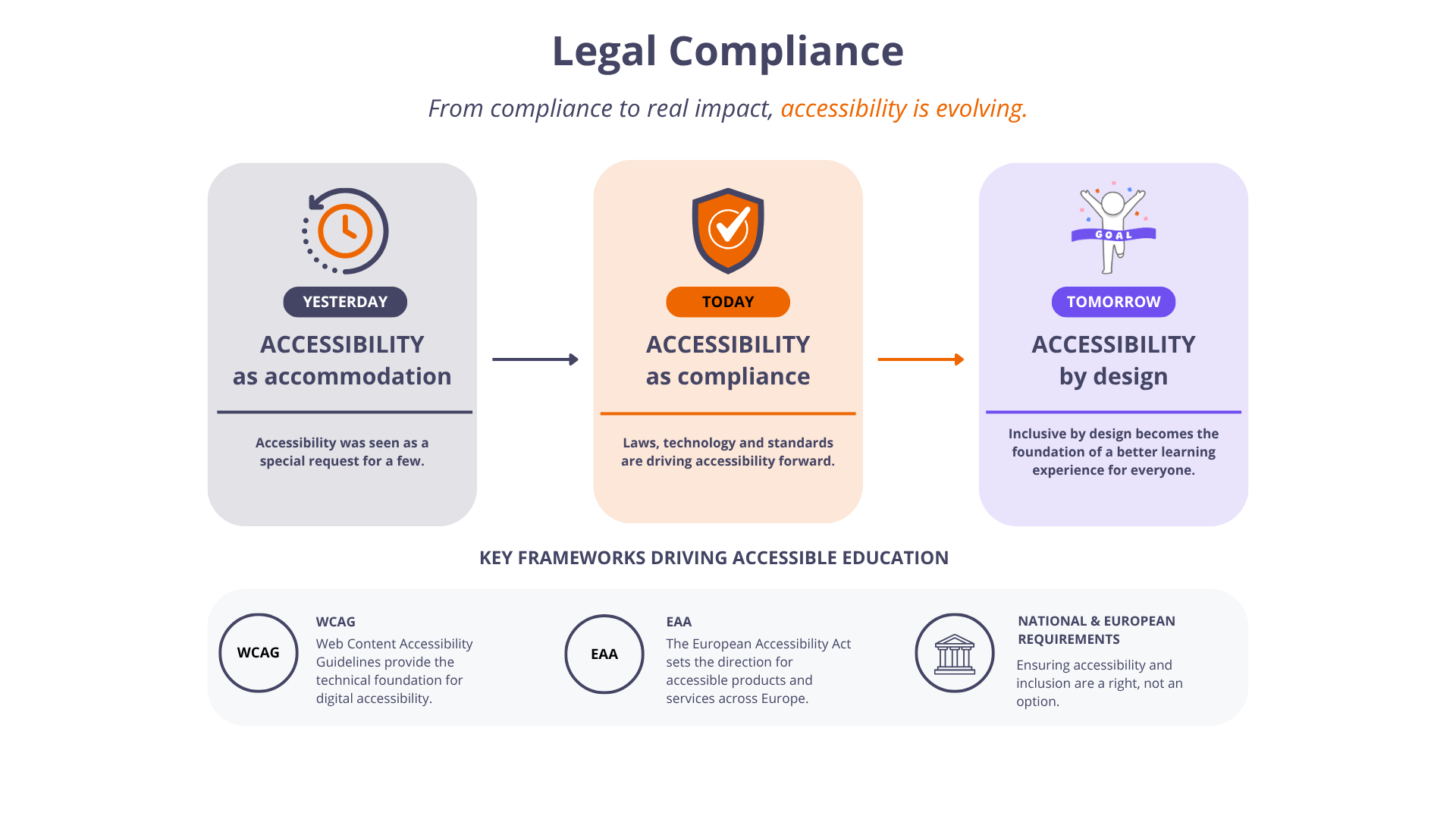
 For many years, digital accessibility was often viewed as a specialist requirement, something organisations implemented primarily to meet legal obligations or provide accommodations for a relatively small number of users. That perspective is changing.
Across Europe, accessibility expectations continue to evolve through legislation such as the European Accessibility Act (EAA), the Web Content Accessibility Guidelines (WCAG), the European AI Act and national accessibility regulations. Together, these frameworks are encouraging educational institutions, publishers and organisations delivering digital learning to embed accessibility into the design of their digital experiences rather than treating it as an afterthought.
The European AI Act is particularly significant because it reinforces a human-centric approach to artificial intelligence. Rather than viewing AI simply as a technological innovation, the regulation emphasises the importance of transparency, fairness and the protection of fundamental rights. For education, this creates an opportunity to ensure that AI-powered tools, including text-to-speech, speech recognition, translation, personalised learning and other assistive technologies, are used to remove barriers, support Universal Design for Learning (UDL) principles and create more accessible learning experiences for everyone.
Compliance remains an important driver, but it is no longer the only one.
Learners increasingly expect digital experiences that are flexible, intuitive and inclusive. They expect to move seamlessly between devices, consume content in different ways and learn at their own pace. Accessibility is therefore becoming an essential component of user experience, improving engagement and participation for a much broader audience than legislation alone was originally designed to protect.
For organisations across the education ecosystem, this represents an important shift.
The conversation is moving beyond “How do we comply?” towards “How do we create learning experiences that work better for everyone?”
The institutions leading this transformation recognise that accessibility is not simply a legal requirement to satisfy, but a long-term investment in learner success, inclusion and educational quality.
When accessibility is embedded from the beginning, within content, digital platforms and learning experiences, it becomes easier to meet regulatory expectations while simultaneously delivering a better experience for every learner.
Compliance may start the conversation, but learner experience is what sustains it.
Legal requirements establish the minimum standard. Building accessible digital learning ecosystems enables organisations to go beyond compliance and create learning experiences that benefit every learner, every day.
Italy’s accessibility journey demonstrates that meaningful change does not happen through isolated initiatives.
It happens when publishers create accessible digital content from the beginning. When universities embed accessibility across increasingly complex digital learning environments. When vocational education providers and employers ensure that learning continues beyond formal education. When institutional organisations promote collaboration, innovation and inclusion. And when legislation provides a framework that encourages accessibility to become part of everyday educational practice.
Each of these elements contributes something different.
Together, they create something much more powerful: an ecosystem where accessibility follows learners throughout their educational and professional journey.
Perhaps the most significant change is not technological or legislative, but cultural.
Accessibility is no longer being viewed solely as a specialist service or an accommodation for a minority of learners. It is increasingly recognised as a characteristic of high-quality digital education; one that improves flexibility, engagement and learner autonomy for everyone.
As education continues to evolve, the organisations that will have the greatest impact are unlikely to be those that simply respond to accessibility requirements. They will be those that embed accessibility into the design of their content, platforms and learning experiences from the outset.
Italy’s education ecosystem shows what this future can look like.
Through collaboration between publishers, universities, adult education providers, institutional organisations, policymakers and technology partners, accessibility is becoming part of the foundation of modern digital learning rather than an addition to it.
Because when accessibility is embedded by design, inclusion becomes part of every learning experience, and every learner has a better opportunity to participate, engage and succeed.
Education
How Moodle Marketplace and Certified Integrations make it easier for institutions to find trusted solutions and build more inclusive learning experiences.
Education
See how ILIAS and ReadSpeaker's text-to-speech technology work together to create more flexible learning experiences, with insights from the University of Stuttgart.
Education
Over the past year, we’ve immersed ourselves in the digital assessment community, through conferences, webinars, research, podcasts, and conversations with assessment leaders. Along the way, several themes have consistently emerged. These are the ideas we believe are shaping the future of accessible digital assessment.