In conversation with gemeente Haacht and web agency LCP
Flanders has required accessible public websites since September 2020. The municipality of Haacht and the web agency LCP tell us what that obligation changed in practice.
Since 23 September 2020, public sector organisations in Flanders have been obliged to make their websites and applications digitally accessible to everyone. That obligation comes from the Flemish law on digital accessibility (opens in a new tab). One in seven people in Flanders has difficulty reading, among them people with low literacy and older people with reduced vision. On top of that, 19 percent of people in Flanders have trouble with digital society because they do not have enough digital skills.
With so many municipalities working on digital accessibility right now, this seemed an excellent moment to put some questions to a web agency, LCP (opens in a new tab), and to a municipality that got started on it quite early: gemeente Haacht (opens in a new tab) (the municipality of Haacht, in Belgium). We began by asking Sara Mertens of gemeente Haacht about their digital transformation.
Sara Mertens, gemeente Haacht
When did you find out that you had to, or wanted to, do something about the accessibility of your website?
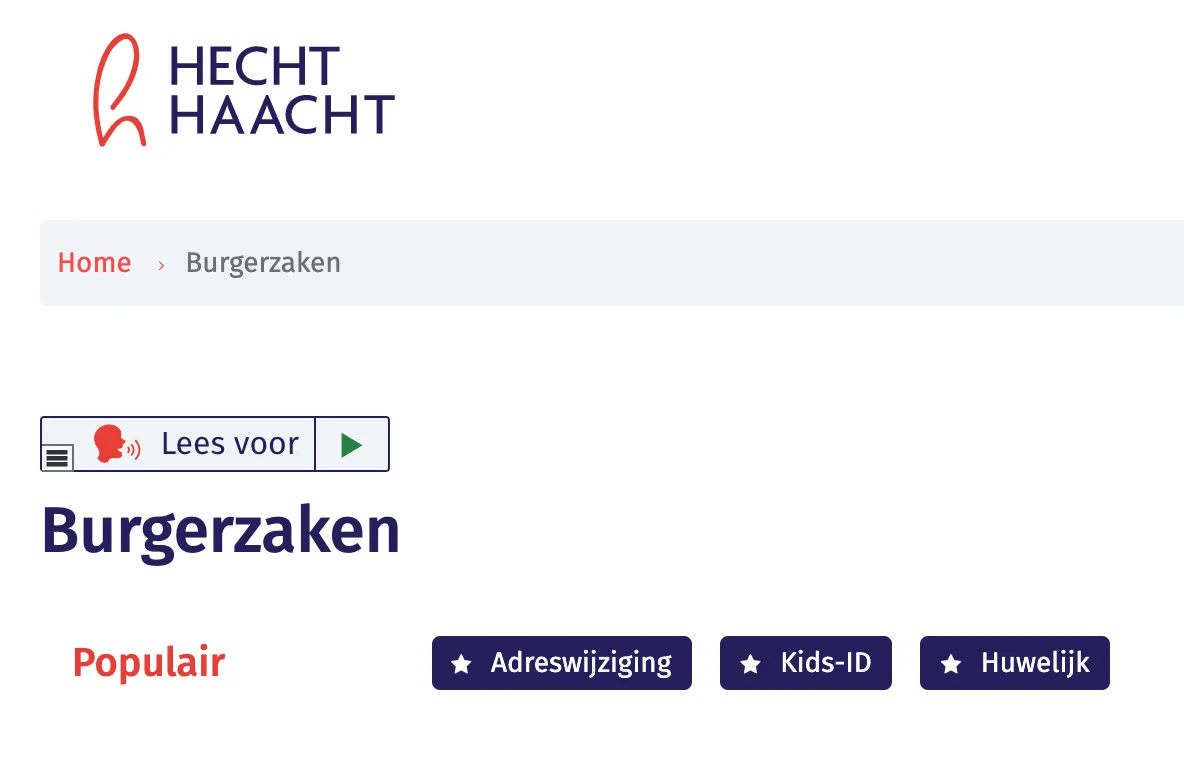
The main reason was the Week van de Geletterdheid (the Flemish literacy week). This year it focused on local government. As a municipality, we want our communication to reach the largest possible audience. All our communication already takes a few plain language principles into account. The ReadSpeaker read-aloud tool is a fine addition to that, and it is not only of interest to people with low literacy. We also reach people with a visual impairment, for example, and people who simply prefer listening to reading. Literacy is broader than reading and writing: it is also about digital literacy.
We made a very deliberate choice to give the listen button a prominent place on our website, so that users do not have to go looking for it. In my view, the place of the button largely determines how successful it is.
Simple implementation, an affordable price, and a number of towns and municipalities that already use it.
Do you get positive reactions about the accessibility of your website, and what do those reactions say?
We have not had any explicit feedback. But the figures speak for themselves: the tool is well used on our website. Promoting it at launch did earn a lot of likes on social media.
Would you recommend ReadSpeaker, and may other municipalities approach you with questions?
Yes, absolutely!
Mieke Vande Kerckhove, web agency LCP
Another organisation in the middle of the digital transformation of municipalities and public bodies is the web agency LCP. We also spoke with Mieke Vande Kerckhove about how they view these changes, and what they notice among their clients.
Are your clients, the municipalities, well aware of WCAG 2.1, and already actively working on accessibility? How alive is the subject?
It is more alive with some than with others. In general they know about it because of the obligation, but it is still something of a distant concern. We find that constant awareness raising is still needed.
How do you look at the law on digital accessibility for public bodies?
It is a best practice that we carry into our quotes and into our contact with clients. We convince them by pointing out that this is not only for the target audience, it is also useful for search engines. In any case, we deliver a high end website that meets the guidelines.
Do your clients ask for a read-aloud tool themselves, or do you point them towards ReadSpeaker?
Clients ask for it themselves. We do draw their attention to it by listing the option in our quotes.
Do you find the implementation of our webReader read-aloud tool easy to carry out?
Yes, it is reasonably simple if you stick to a basic integration. If you want to integrate the read-aloud tool completely seamlessly, so that it fits in more elegantly, that takes a bit more time.
Do you ever use our support department? If so, what is your experience?
Sometimes, and there is always a quick answer. Thank you for that!
ReadSpeaker is delighted to be working with gemeente Haacht and LCP, and glad to be able to share their story and their view of digital transformation. Curious how we could support yours? Get in touch and we will look together at a solution that fits.
Accessibility doesn’t end when a course is published. It continues throughout the learner journey. Discover how ReadSpeaker and Brickfield, as Certified Moodle Integrations, help institutions build accessibility into every stage of learning.
The importance of transparency, accessibility, deployment control, and trustworthy digital communication across enterprise, industrial, public service, and learning environments
Nearly one year after the European Accessibility Act, mobile accessibility is reshaping inclusive UX. See how audio-assisted experiences and text to speech support more flexible mobile interactions.
·8 min read
We build ethical technology that respects every user. Your privacy is no exception. Before you choose, we measure how the site is used without any cookie and without identifying you. Everything else waits for your consent.