Implementing Secure On-Premise TTS for Financial Institutions: Data Sovereignty in BFSI
Discover how on-premise text to speech provides financial institutions with total data sovereignty, GDPR/EAA compliance, zero-latency voice banking, and secure infrastructure.
For banking, financial services, and insurance (BFSI) institutions, security and regulatory compliance are not merely operational priorities; they represent the foundation of customer trust. While public cloud platforms offer rapid deployment, the requirement to keep sensitive customer data within a strictly controlled environment remains essential.
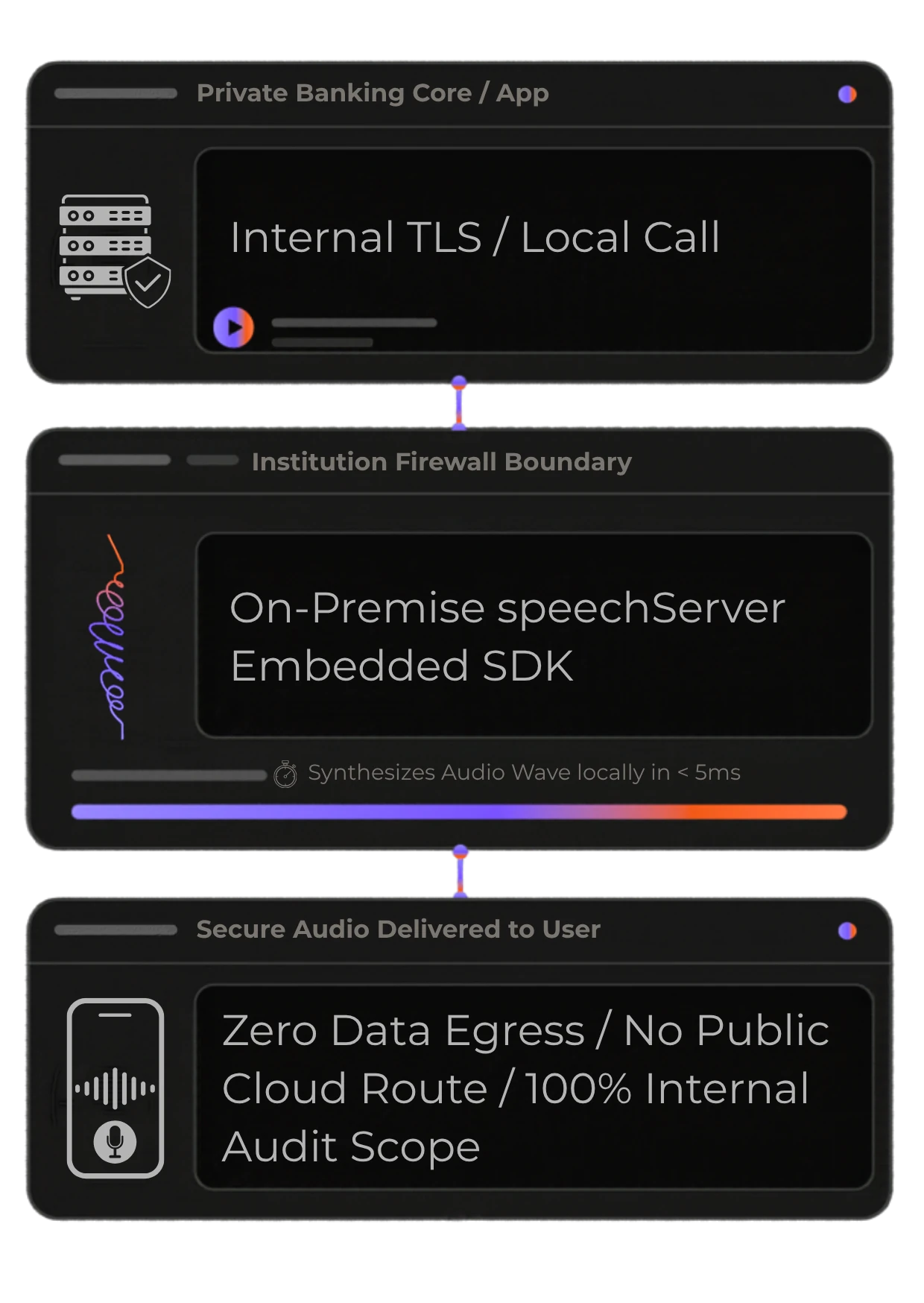
This is precisely why text-to-speech (TTS) technology deployed on premise is becoming a core component of modern financial infrastructure. By integrating speech synthesis directly into their internal server environment or mobile application layers, financial institutions can deliver dynamic voice interactions while maintaining total data sovereignty.
Why On-Premise TTS is Critical for BFSI Compliance
Traditional cloud-based speech synthesis presents a significant compliance challenge: it requires sending customer data, even if temporarily, outside the institution's secure network for processing. In a sector handling account balances, transaction histories, and personally identifiable information (PII), this external exposure is often unacceptable.
With an on-premise TTS deployment, all text processing and voice synthesis occur entirely within your internal network. Customer account details, financial statements, and proprietary data never cross your firewall. This ensures the highest level of security available, keeping customer data completely isolated from third-party cloud servers.
2. Seamless Regulatory Governance
Financial institutions operate under strict data protection and governance frameworks, including GDPR, PCI DSS (Payment Card Industry Data Security Standard), and the European Accessibility Act (EAA). Deploying on premise keeps all processing within your institution's secure perimeter. Because no data leaves your network, your security team retains complete authority over the data lifecycle, simplifying compliance reviews and risk assessments.
3. Guaranteed Uptime and Autonomous Performance
On-premise solutions operate independently of public internet availability. This guarantees consistent, high-speed audio generation without the risk of latency spikes, network congestion, or service disruptions caused by external cloud outages. Critical financial services remain operational 24/7.
Core Benefits for Financial Applications
Deploying secure speech synthesis behind your corporate firewall directly translates into safer, more accessible digital services across all customer touchpoints:
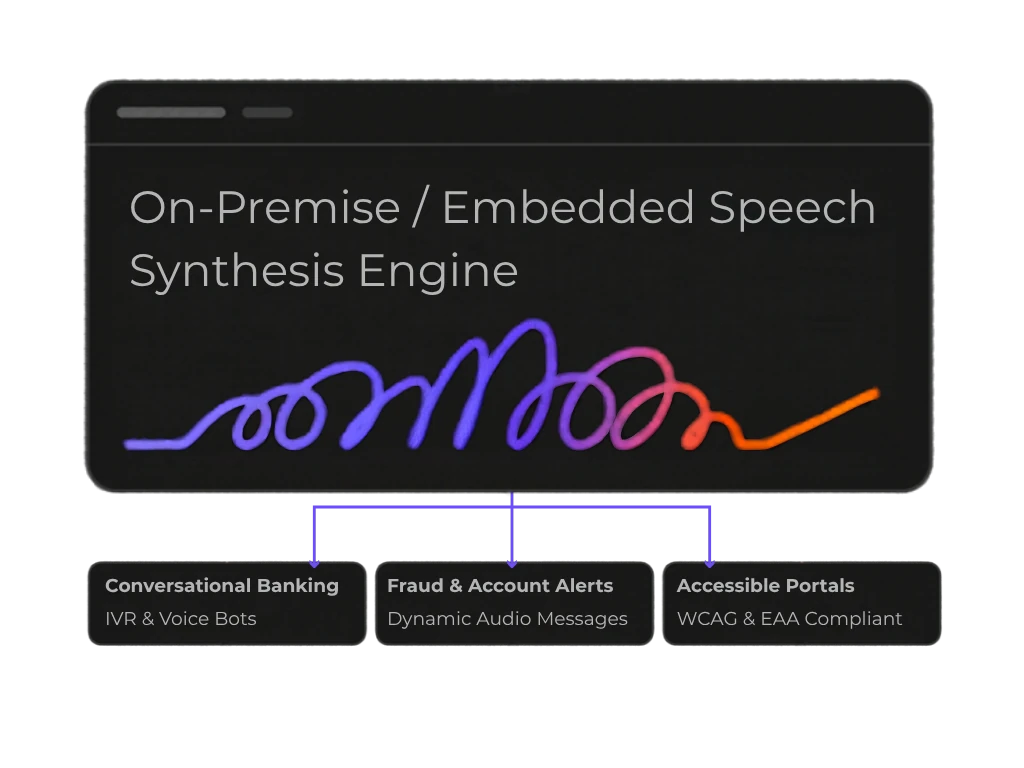
Enable secure, voice-assisted actions within your mobile apps and IVR telephony systems, such as balance enquiries, transfer confirmations, and real-time fraud alerts. Because speech generation takes place within your internal environment, customer interactions remain protected against external interception or unauthorized logging.
Automated, Auditable Customer Notifications
Deploy automated text to speech to generate real-time audio communications regarding market updates, policy changes, or security alerts. These messages can be generated dynamically using custom pronunciation dictionaries, ensuring technical financial jargon, currency codes, and complex terms are spoken with absolute phonetic accuracy.
Inclusive Digital & Physical Banking Environments
Improving accessibility across online banking portals, mobile apps, and electronic documents directly supports compliance mandates such as WCAG 2.2 AA guidelines and the European Accessibility Act (EAA). However, true enterprise accessibility extends beyond legal frameworks to embrace broader diversity, equity, and inclusion initiatives that cater to diverse customer needs.
Integrating speech synthesis into financial services and banking systems, and cloud-hosted fintech SaaS platforms provides an essential auditory layer across both digital touchpoints and physical banking infrastructure.
Deploying embedded or on-premise text to speech on physical ATMs, smart teller terminals and interactive self-service banking kiosks ensures that visually impaired, neurodiverse, and elderly customers can navigate menus, review account balances, and execute private financial transactions independently.
Whether accommodating older adults adapting to digital migration, individuals managing situational limitations, or neurodiverse clients with dyslexia or cognitive processing differences, TTS transforms mandatory regulatory compliance into a dignified, inclusive and user-centric banking experience for every customer.
Brand Identity and Trust
Deliver a consistent, professional audio experience across every customer touchpoint, from automated phone systems to personalized mobile app prompts. Institutions can deploy high-quality standard neural voices for everyday transactional alerts, or partner with ReadSpeaker for custom neural voice development to craft an exclusive, recognizable brand voice that reinforces customer confidence.
CTO & Security Takeaway: Operating on-premise eliminates third-party data egress, simplifies GDPR compliance audits, aligns with internal ISO/IEC 27001 security controls, and ensures zero network dependency.
Product & Compliance Takeaway: Localized speech synthesis enables seamless WCAG AA and EAA accessibility compliance across digital banking portals while preserving a consistent, high-quality audio brand across all digital channels.
FAQ
Q: Why is on-premise TTS preferred over cloud TTS for financial institutions?
A: On-premise TTS processes text and audio entirely behind the bank's internal firewall. This eliminates the risk of sending sensitive customer data or transaction details across public cloud networks, satisfying strict GDPR and PCI DSS data sovereignty requirements while aligning with internal ISO/IEC 27001 security frameworks.
Q: Does on-premise TTS support compliance with the European Accessibility Act (EAA)?
A: Yes. By embedding text to speech directly into web portals, mobile apps, and PDF documents, financial institutions meet EAA and WCAG AA accessibility standards without exposing user data to third-party tracking or external APIs.
Q: Can an on-premise TTS solution scale to handle high transaction volumes?
A: Yes. On-premise TTS engines scale horizontally across your private server infrastructure or edge devices, delivering consistent audio in under 5 milliseconds without character-based cloud usage fees or external bandwidth limits.
Conclusion: A Strategic Investment in Trust
Implementing an on-premise TTS solution is more than a technical upgrade; it is a strategic investment in the security, compliance, and overall trustworthiness of your financial institution. It allows you to harness advanced voice technology to enhance digital accessibility and deepen customer engagement, all while maintaining complete control over your data, performance, and reputation.
Ready to explore how a secure, on-premise TTS solution can elevate your financial services while eliminating data risk? Explore our financial services and banking systems solutions and discover how our security SDKs integrate seamlessly into your enterprise architecture.
A custom voice is more than a synthetic voice model. For an enterprise, it can become a long-term communication asset used across products, customer services, applications and operational systems. This guide explains how enterprise custom voices are planned, created, governed and deployed.
Why a standardized TTS strategy is the key to reducing costs and improving the user experience across a complex transportation network.
·5 min read
We build ethical technology that respects every user. Your privacy is no exception. Before you choose, we measure how the site is used without any cookie and without identifying you. Everything else waits for your consent.