When building voice-enabled applications, digital product teams face a fundamental choice: the instant convenience of a cloud-based API or the complete control of an embedded or on-premise Software Development Kit (SDK).
Cloud APIs from hyperscalers are ideal for quick consumer prototypes. However, as applications scale into mission-critical environments requiring strict data privacy, low latency, and deep system integration, cloud dependencies quickly become a bottleneck.
Moving beyond generic cloud endpoints, a specialized TTS SDK gives engineering and product leaders the security, performance, and operational autonomy that modern enterprise applications demand.
What is the Difference Between a TTS SDK and a Cloud API?
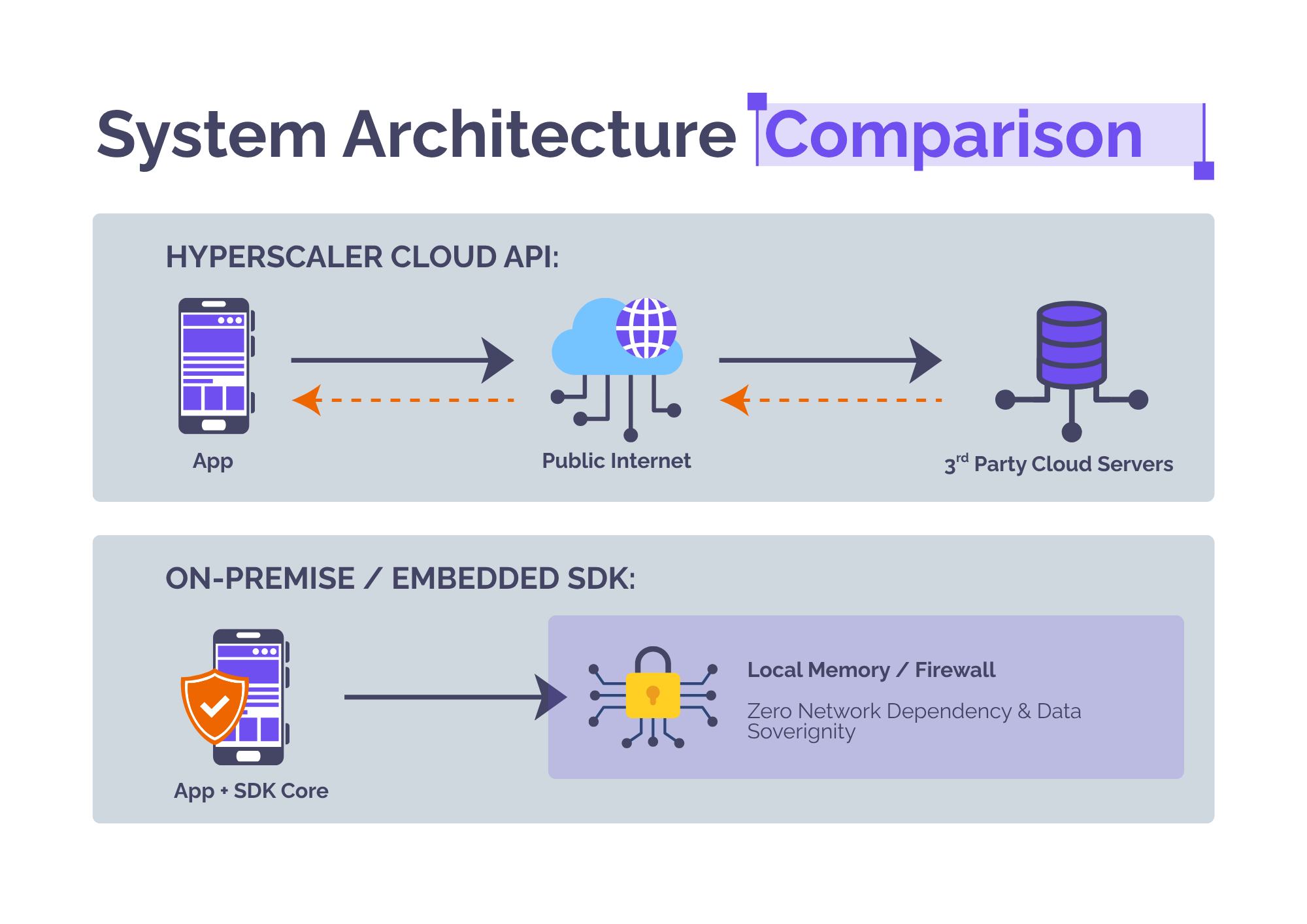
A cloud TTS API requires applications to send text strings over the public internet to an external vendor server for synthesis, returning an audio stream. This model depends heavily on constant network availability, public routing stability, and recurring pay-per-character fees.
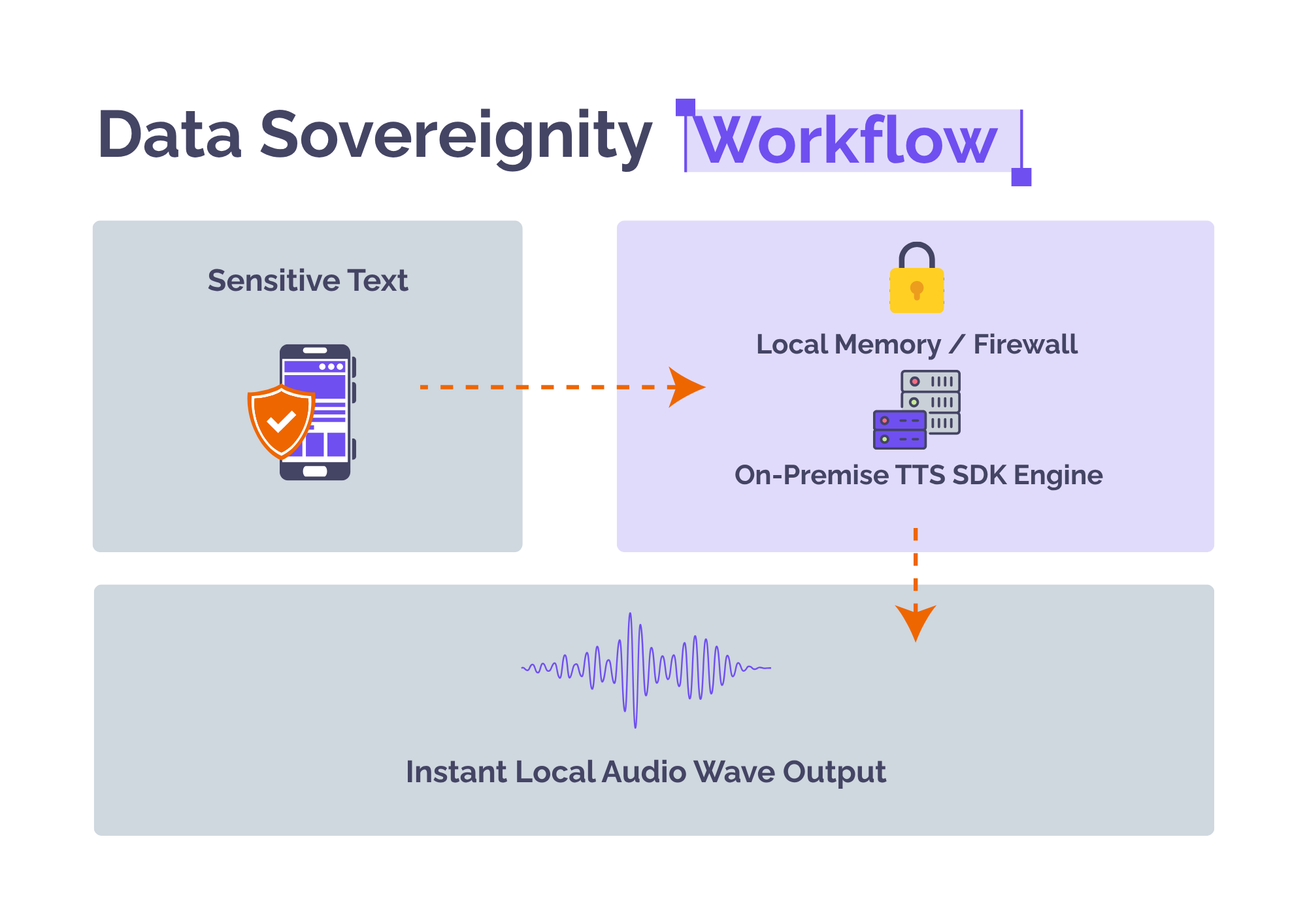
In contrast, a TTS SDK embeds the speech synthesis engine directly into the local application runtime layer or on-premise server. All speech generation occurs locally with low latency, offline resilience, and total data isolation behind your corporate firewall.
1. Data Isolation: Securing Sensitive Information Behind Your Firewall
For organisations handling regulated data, such as financial statements, health details, or student records, transmitting text for synthesis across external cloud boundaries introduces unnecessary compliance risk.
Using an embedded SDK or on-premisespeechServer infrastructure ensures that all text processing occurs within your controlled infrastructure. Text never leaves your secure environment, simplifying compliance audits and protecting user privacy.
CTO & Security Takeaway: Operating on-premise satisfies strict regulatory standards such as GDPR, the European Accessibility Act (EAA), and ISO/IEC 27001. You retain full ownership of logging, data handling, and audio generation without third-party exposure.
Product & Integration Takeaway: In financial services and banking systems, on-premise voice synthesis ensures that private balance statements and customer interactions are generated locally, accelerating security clearance for mobile apps and conversational voicebots.
2. Architectural Flexibility: Native Embedding Across Mobile, Edge and Desktop Applications
Generic cloud APIs are built for standard web applications, often falling short when low-level execution inside local software runtimes, mobile platforms, or edge hardware is required.
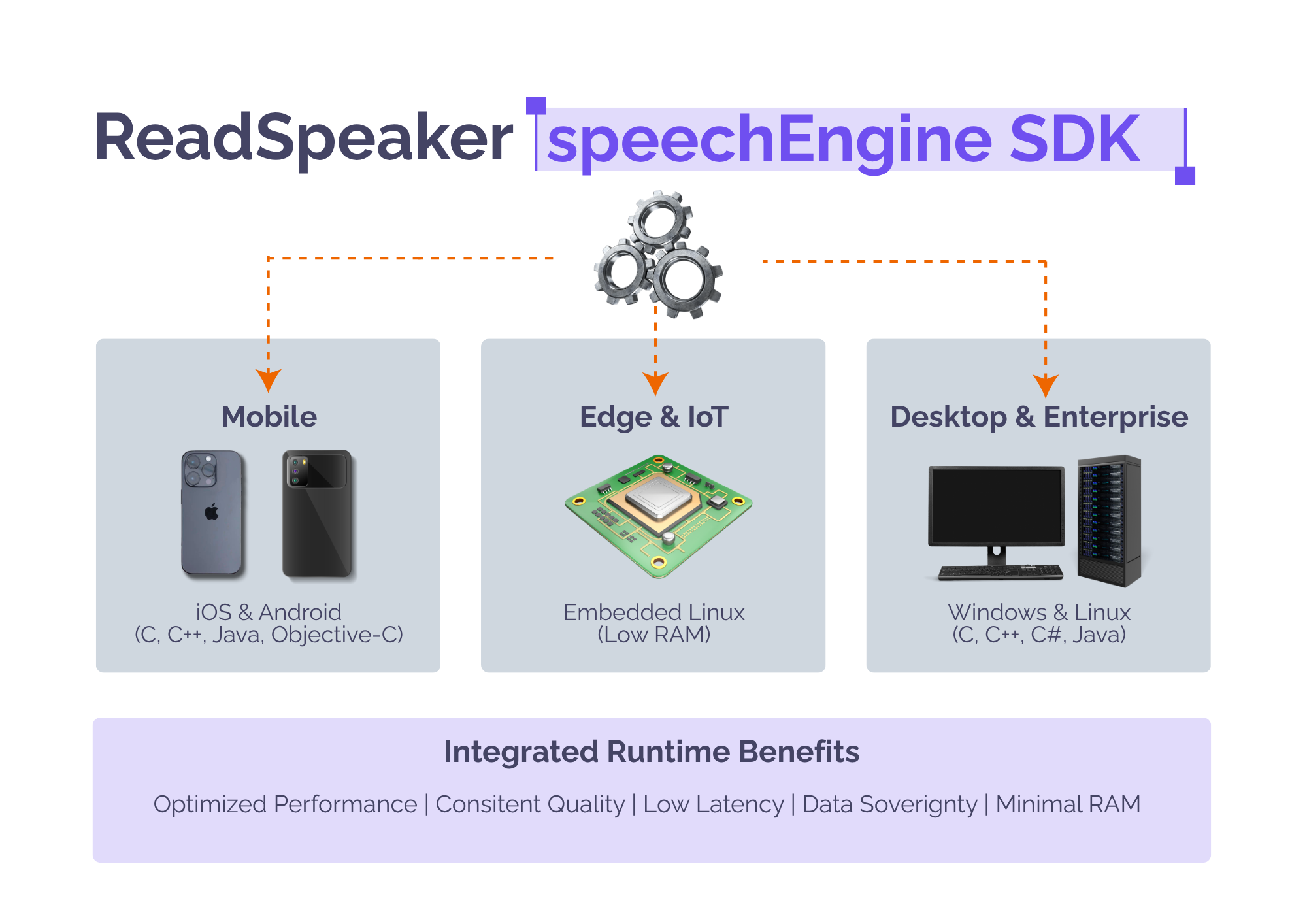
ReadSpeaker speechEngine SDKs provide native libraries for multiple programming environments, including C, C++, C#, Java (Android), and Objective-C (iOS). This flexibility allows engineering teams to embed voice capabilities directly into existing software architectures without building complex, costly middleware.
Mobile & Edge Operating Systems: Native integration within iOS, Android, and Embedded Linux environments. The embedded SDK enables offline speech output, background audio generation at low latency without external network dependencies or bandwidth throttling.
Desktop & Local Enterprise Software: Direct compilation into Windows and Linux applications via C/C++, Java, and C#, giving engineering teams total control over thread management, buffer sizes, and local audio streaming.
3. Efficiency at Scale: Low Latency and Edge Footprint Optimization
In hardware-constrained environments, such as mobile apps, automotive cabins, and IoT equipment, system memory and processing efficiency are critical metrics.
Cloud APIs rely on external high-power cloud servers, making audio response times vulnerable to network latency and bandwidth throttling. An embedded SDK operates locally with a small memory footprint, maximizing battery efficiency and delivering instant audio playback.
Software Integration Takeaway: Local execution eliminates external network calls, reducing round-trip audio latency. This makes embedded SDKs ideal for real-time applications such as automotive navigation, industrial machinery controls, and mobile utilities.
Product Lead & TCO Takeaway: Operating on-premise or on-device transforms unpredictable, character-based cloud usage bills into a predictable, fixed licensing cost, making product scaling highly economical for high-volume deployments.
4. Brand Voice Precision: Custom Pronunciation, SSML, and Lexicon Control
Maintaining brand authority and operational clarity requires absolute precision when pronouncing technical terminology, brand names, and complex industry jargon. Off-the-shelf cloud voices often mispronounce specialized words, and vendor customization options can be restrictive.
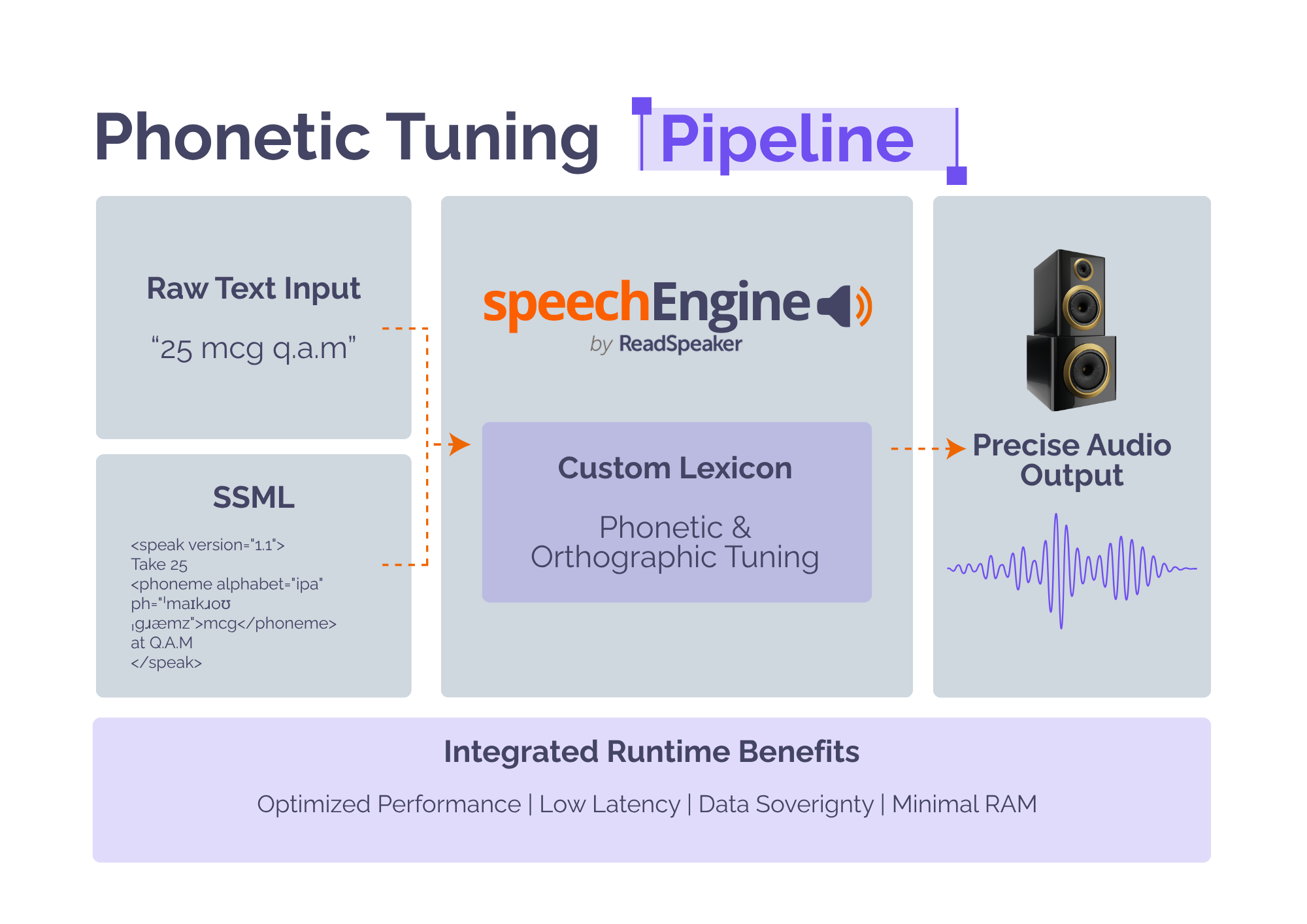
A dedicated enterprise TTS engine provides fine-grained control through Speech Synthesis Markup Language (SSML) and custom pronunciation dictionaries.
Linguistic Precision: Manage custom lexicons down to the phoneme level to ensure that specialized medical shorthand, legal terms, and regional place names are spoken correctly every time.
Brand Identity: Enterprise teams can combine custom lexicons with VoiceLab custom neural voice development to create a unique, brand-aligned voice that sets their digital products apart from generic cloud presets.
FAQ
What is the main advantage of a TTS SDK over a cloud API?
A TTS SDK installs locally on-device or on an on-premise server, providing absolute data privacy, low latency, offline resilience, and predictable licensing costs. A cloud API processes text on external vendor servers, introducing network latency and data compliance dependencies.
How does an embedded TTS SDK support offline functionality?
Because the synthesis engine resides entirely on-device, an embedded TTS SDK generates high-quality speech without requiring an active network connection.
Is on-premise TTS compliant with GDPR and the European Accessibility Act?
Yes. Because text processing occurs entirely behind your corporate firewall without data leaving your secure application environment, on-premise TTS simplifies compliance with GDPR and the European Accessibility Act (EAA).
Conclusion: Build Secure, Scalable Voice Experiences with Confidence
The choice between a generic cloud API and a specialized TTS SDK comes down to convenience versus control. For enterprises that prioritize data isolation, low latency, seamless system integration, and predictable total cost of ownership, an embedded or on-premise SDK provides a fundamentally superior architecture.
Ready to take full control of your voice technology? Explore our on-premise infrastructure and discover how secure, enterprise-grade text-to-speech can integrate seamlessly into your software stack.
A custom voice is more than a synthetic voice model. For an enterprise, it can become a long-term communication asset used across products, customer services, applications and operational systems. This guide explains how enterprise custom voices are planned, created, governed and deployed.
Nearly one year after the European Accessibility Act, mobile accessibility is reshaping inclusive UX. See how audio-assisted experiences and text to speech support more flexible mobile interactions.
·8 min read
We build ethical technology that respects every user. Your privacy is no exception. Before you choose, we measure how the site is used without any cookie and without identifying you. Everything else waits for your consent.