Across the world, technical universities, polytechnics, vocational colleges, national training bodies, and employers share the same urgent mandate: build a workforce capable of powering the next industrial era.
But attracting, supporting, and retaining the next generation of learners into Technical and Vocational Education and Training (TVET), and then ensuring they have the right lifetime of skills in the workplace, has never been more challenging.
We are accelerating into a world shaped by AI, green technologies, demographic change, and widespread labor shortages. Governments, training colleges and employers know they must respond, but many are struggling to keep pace.
Why Traditional Investment Strategies Fall Short
The conversation around the growing global skills gap tends to follow a familiar script. We need more training places, more apprenticeships, more investment. Build capacity, and the problem will ease.
But despite growing awareness and sustained funding, the gap is not closing. This suggests the problem goes deeper. It’s not just about providing more training. It’s about changing the way in which we design and deliver today’s vocational learning.
What Are the Real Constraints in Vocational Training?
A significant proportion of employers facing labor shortages say the problem lies in evolving skill requirements rather than a lack of applicants. Over half of hard-to-fill roles across OECD countries are in high-skill technical or digital occupations. And a growing number of organisations report a mismatch between the skills their workforce has and the skills they need.
Even when learners enter vocational pathways, too many struggle to complete their courses, or to translate what they learn into real-world performance. At the same time, employers are finding that training delivered in the workplace often fails to scale, adapt, or engage the people it is meant to support.
In both cases, the underlying problem is the same: the format of learning has not kept pace with the demands placed upon it.
How Can Modern TVET Meet the Needs of a More Diverse Population?
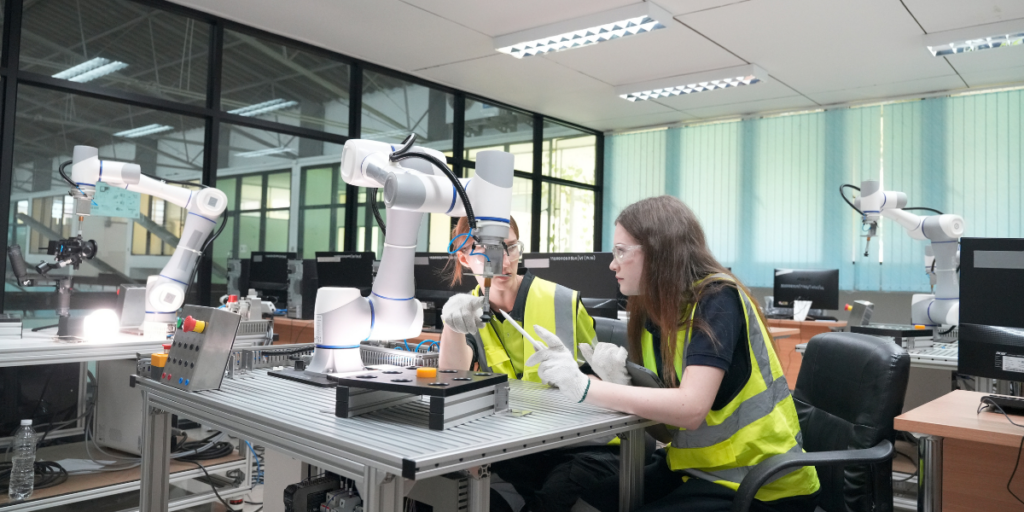
Vocational education today serves a far broader and more diverse population than it did even a decade ago. It includes school leavers taking their first steps into employment, as well as mid-career professionals retraining into new sectors, multilingual learners navigating unfamiliar labor markets, and individuals returning to education after long periods in work.
It also includes more neurodivergent learners — individuals who may have struggled in traditional academic settings, not because of a lack of ability, but because those environments placed heavy emphasis on abstract, text-based learning. In vocational pathways, where learning is more applied and practice-led, these learners often find a better match for how they process information and develop skills.
All these learners bring different experiences, strengths, and ways of engaging with information. But the environments they enter are often remarkably uniform.
Across many vocational systems, learning is still delivered through dense written materials, lecture-led instruction, and assessments that prioritise recall over application. This model assumes a high level of reading fluency, comfort with abstract theory, and the ability to absorb knowledge before putting it into practice.
For many learners, that is where the friction begins. The issue is not capability. It is about accessibility and alignment. When the format of learning does not reflect how people actually learn, or how they are expected to work, even motivated learners begin to disengage.
Why Don’t Current Investment Models Address Core Learning Barriers?
Around the world, governments are investing heavily in skills strategies, apprenticeship reform, and workforce development initiatives. These efforts are essential, and in many cases long overdue.
Germany, for example, is often held up as a benchmark for vocational education, with its well-established dual system and strong industry links. Recent reforms have focused on modernising apprenticeship standards, expanding training opportunities, and aligning programmes with digital and green-skill requirements.
And yet, even here, challenges persist. Apprenticeship uptake has not fully recovered to pre-pandemic levels, dropout rates remain significant in some pathways, and forecasts suggest a growing shortage of vocational educators in the years ahead.
These pressures highlight a critical point. Expanding capacity and updating curricula are necessary, but they are not sufficient on their own. If the underlying format of learning remains unchanged, many of the same barriers will simply be reproduced at scale.
What Does Cognitive Science Tell Us About Effective Technical Learning?
Research in cognitive science and instructional design has, for decades, pointed toward a more effective model of technical learning. It is consistently more successful when it is multimodal, closely tied to practical application, and available at the moment it is needed.
In practice, this means that learners benefit from being able to combine visual, auditory, and hands-on inputs, rather than relying on text alone. It also means that guidance should be accessible during the act of performing a task, not only beforehand.
This is particularly important in vocational contexts, where understanding and execution are deeply connected. When learning is delivered primarily through text-heavy materials, it places a significant burden on working memory. For multilingual learners, those returning to education, or individuals with different cognitive processing styles, that burden can become a barrier.
The result is not just slower progress, but reduced confidence and, ultimately, disengagement (see our related blog on ways to improve TVET engagement).

How Do Current Training Formats Create Learning Barriers?
In addition, the nature of work itself has changed. Many of the roles that vocational education prepares people for now involve dynamic environments, real-time decision-making, and continuous adaptation.
In these contexts, learning cannot remain separate from doing. It needs to be embedded within it.
Yet in many systems, there is still a clear divide between theory and practice. Learners are expected to absorb information in one setting and apply it in another, often with limited support in between. This gap is where capability is lost, not because individuals are unable to perform, but because the way knowledge is delivered does not translate easily into action.
What Should Replace Traditional Learning-Content-Delivery Models?
Closing the skills gap therefore requires more than expanding access to training. It requires a shift in how learning itself is designed.
This means moving away from a model centred on content delivery, toward one focused on experience. Learning must become something that adapts to the learner, supports different modes of engagement, and aligns more closely with the realities of work.
In practical terms, this involves reducing reliance on text as the default medium, supporting multilingual access, and ensuring that guidance can be accessed in context, rather than only in advance. Technology has an important role to play in this shift, but not as an add-on. Increasingly, it is becoming part of the infrastructure through which learning is delivered.
How Does Audio-Enabled Learning Transform Accessibility?
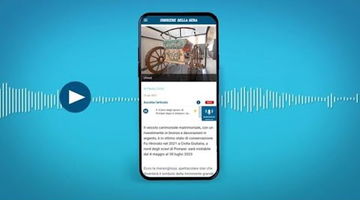
Text-to-Speech (TTS) technology is one example of how this transformation is already taking shape. By converting written materials into spoken language, it allows learners to engage with content in a more flexible and immediate way.
Instead of being tied to a screen, learners can access guidance while commuting, during work tasks, or in short intervals throughout the day. For those working in a second language, or managing dense technical vocabulary, audio support reduces the effort required to process information, freeing up cognitive capacity to focus on understanding and application.
This shift from static content to usable guidance can have a measurable impact. At Penn Foster, a provider of flexible vocational education serving a large population of adult learners, integrating voice-enabled learning into course delivery led to a significant increase in engagement. Within a short period, course completion rates rose sharply, while the time taken for learners to reach key milestones decreased. Learners were able to fit study more naturally into their daily routines, listening to materials while working, travelling, or managing other responsibilities.
What changed was not the content itself, but how it was accessed.
How Should Assessment Evolve Beyond Traditional Formats?
The same principle applies to assessment. In many vocational systems, the way competence is evaluated has not evolved at the same pace as expectations around inclusion and accessibility.
Professional Assessment Ltd, an organisation providing end-point assessments for apprenticeships, previously relied on human readers to support candidates who needed assistance during on-screen exams. While compliant, this approach was resource-intensive and difficult to scale, and it introduced variability into the assessment experience.
By embedding TTS directly into their digital assessment platform, the organisation was able to provide consistent, on-demand support to all learners who required it. Candidates could control the pace of delivery, revisit information independently, and engage with the material in a way that suited their needs.
In this way, voice technology does more than improve accessibility. It creates a more reliable and equitable assessment environment, while reducing operational complexity.
“Instead of relying on staff to act as readers, the technology gives every learner consistent, high-quality support — instantly and independently. It helps us meet our compliance obligations and, more importantly, ensures no learner is disadvantaged when demonstrating what they know,” Paul Kelly, Qualifications Director, Professional Assessment Ltd
How Does Workplace Learning Require Similar Transformation?
The need for this kind of flexibility does not end when learners leave formal education. In many ways, it becomes more urgent, an issue we discussed in our piece on embedding accessible learning into workshops and labs.
Employers are now responsible for continuous upskilling, often across geographically distributed teams and in multiple languages. Training must be delivered quickly, updated frequently, and applied immediately in operational contexts.
Some organisations are beginning to address this by embedding voice more deeply into their learning ecosystems. At CLAAS, a global manufacturer of agricultural machinery, training programmes span multiple regions and languages, with highly specialised technical terminology.
Ensuring that this content is delivered clearly and consistently is critical, not only for learning outcomes, but for safety and operational accuracy. By developing a tailored TTS solution that reflects its specific vocabulary and pronunciation requirements, CLAAS was able to standardise training delivery across its global network. This reduced ambiguity, improved clarity, and made it easier to scale learning across different markets.
The value lies not just in accessibility, but in alignment between how learning is delivered and how work is performed.
What Does a Connected Learning Ecosystem Look Like?
No single intervention will close the skills gap on its own. The scale of the challenge requires coordination across institutions, employers, and technology providers.
This shift is already underway. Partnerships are forming that cut across traditional boundaries between education and enterprise, bringing together platform expertise, content delivery, and accessibility in more integrated ways.
Across the globe, for example, partnerships such as our collaboration with Moodle specialist Vextur are helping organisations rethink how training is delivered across sectors as varied as vocational education, aviation, healthcare, and logistics. By combining deep LMS expertise with embedded voice capabilities, these partnerships are enabling institutions and employers to move beyond fragmented solutions and build learning environments where accessibility is part of the experience from the outset.
“Together, we’re helping organisations create learning experiences that work for every learner, regardless of need or context,” Paulius Nomgaudas, CEO, Vextur.
The impact is practical as much as strategic. Learning content can be localised more quickly, delivered more consistently across regions, and accessed in ways that reflect how people actually work and learn day to day. Rather than adapting systems after the fact, organisations are beginning to design them with inclusion and flexibility built in.
This reflects a broader shift: inclusive, multimodal learning is no longer delivered by a single institution or tool. It is created across connected systems, where responsibility for learner success is shared — and where the boundaries between education and the workplace are increasingly blurred.
The result is not just better tools, but more coherent systems, in which learners encounter similar experiences as they move from education into employment and continue to develop their skills over time.
What Fundamental Shift Does TVET Need?
There is no shortage of people capable of developing the skills needed for the future. What is in short supply are systems that reflect how people now learn, work, and adapt.
As long as vocational education and workplace training rely on formats that prioritise text, separate learning from doing, and assume uniform learner needs, the gap between potential and performance will persist.
Closing the global skills gap therefore depends on a shift in perspective. We need to stop asking how we can train more people, and start asking how we can design learning that works for more people.
When learning becomes more accessible, more flexible, and more closely aligned with real-world practice, the impact extends beyond individual outcomes. It strengthens entire systems, making them more resilient, more inclusive, and better equipped to support our workforce of the future.
FAQs
How can institutions begin transitioning from text-heavy to multimodal learning?
Start by auditing current content delivery methods and identifying high-dropout or challenging courses. Pilot audio-enabled learning in these areas, focusing on dense technical materials or multilingual learner populations. Measure engagement and completion rates to build evidence for broader implementation.
What role does technology play in making vocational learning more inclusive?
Technology serves as infrastructure rather than an add-on, enabling flexible content access through voice, supporting real-time guidance during practical tasks, and reducing cognitive load for diverse learners. The key is embedding accessibility features into core learning systems rather than treating them as separate accommodations.
How do employers measure success when shifting to experience-based learning models?
Success metrics should focus on practical application rather than content consumption. Look for reduced time-to-competency, improved on-the-job performance, lower training support ticket volumes, and increased learner confidence in applying skills in real work contexts.
What prevents traditional assessment methods from accurately measuring vocational competence?
Traditional assessments often evaluate recall rather than application, rely heavily on text-based formats that don’t reflect actual work environments, and create artificial barriers for neurodivergent or multilingual learners. Modern assessment should mirror real workplace conditions and support diverse ways of demonstrating competence.
How can small training providers compete with larger institutions in implementing inclusive learning technologies?
Focus on partnerships with technology providers that offer integrated solutions rather than building custom systems. Leverage existing LMS integrations and prioritize technologies that require minimal IT infrastructure while maximizing learner accessibility and engagement.
The Bottom Line
Closing the global skills gap requires shifting from expanding training capacity to redesigning how vocational learning works. When institutions move beyond text-heavy, one-size-fits-all approaches to embrace multimodal, accessible learning that reflects real workplace conditions, they unlock potential across diverse learner populations and create more resilient workforce development systems.
Want to see what text to speech would look like for your organization?
Contact us for a demo

With extensive experience in EdTech and Product Marketing, Leo has led international campaigns and content strategies for Augmented Reality (AR) and Artificial Intelligence (AI) EdTech companies.
He loves to focus on how technology can empower new generations to learn, grow, and reach their full potential — both personally and professionally.
Passionate about engaging communication, Leo works to make learning experiences more inclusive and impactful for all.