Education
Building Trusted Learning Ecosystems in Moodle That Are Ready for What's Next
How Moodle Marketplace and Certified Integrations make it easier for institutions to find trusted solutions and build more inclusive learning experiences.
July 11, 2025
As the June 2025 compliance deadline approached, EdTech leaders explored how the European Accessibility Act can be a catalyst for innovation, inclusion, and long-term strategy, not just legal obligation. Discover the key takeaways from this essential roundtable.
 Amy Foxwell4 min read
On June 17th, leaders from policy, education, and technology convened for a critical discussion on the European Accessibility Act (EAA)
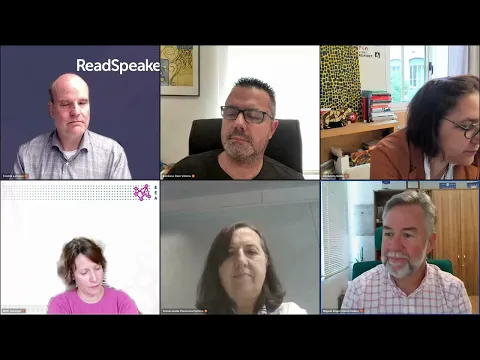
Hosted by ReadSpeaker and moderated by Donatella Solda, President of EdTech Italia, the virtual roundtable explored not just the legal requirements ahead of the June 28, 2025 compliance deadline, but how the EAA can become a lever for inclusion and innovation across digital learning.
The EAA aims to ensure that digital products and services are accessible to everyone, including those with disabilities. It applies to a wide range of industries and sectors, including EdTech, and mandates that platforms, tools, and content be designed to meet rigorous standards such as WCAG 2.2 AA and EN 301 549.
Inmaculada Placencia Porrero, Senior Expert on Disability at the European Commission and lead architect of the EAA, opened the session by providing essential clarity. She emphasised that while the legislation includes compliance requirements, the goal isn’t to punish organisations.
Authorities are not looking to impose fines immediately. Instead, they aim to advise companies on how to correct mistakes and improve accessibility.
 (play video)
The June 2025 deadline represents a turning point for digital inclusivity in Europe, but it also offers organisations a chance to future-proof their platforms and differentiate themselves in the marketplace.
Several speakers underscored the idea that accessibility shouldn’t be framed as a burden, but rather as a strategic advantage.
Fredrik Larsson, Co-founder of ReadSpeaker, highlighted the benefits of accessible tools like text-to-speech (TTS). These are not only indispensable for people with visual impairments or dyslexia, but also enhance usability for language learners, mobile users, and multitaskers.
When you build for accessibility, you often end up improving the experience for everyone, Fredrik said.
Emiliano Díez Villoria, Professor of Psychology at the University of Salamanca and Director of the University Institute for Community Integration (INICO), added that focusing purely on technical fixes can miss the broader opportunity. He urged stakeholders to embed accessibility into pedagogy, curriculum design, and the wider educational culture.
It’s a mistake to confuse the means with the goal of learning. Instead of asking for exceptions, we should ask: what’s the real objective of this task? And how can we offer multiple, flexible pathways to achieve it?
 (play video)
A recurring challenge raised during the roundtable was how to handle complex content types, such as interactive exercises or language learning materials, in ways that remain accessible.
Emiliano addressed concerns around making textbooks (in PDF or HTML formats) compliant with AA standards, particularly for language learners.
We always design with a ‘standard’ user in mind. Then, when we adapt for accessibility, it feels like an afterthought. But accessibility should be baked in from the start. We need to rethink what a ‘book’ even is, and we should co-design content with people who have diverse needs.
This philosophy of inclusive-by-design resonated across the session, especially in discussions about digital platforms that supplement printed textbooks. Whether it’s video content, interactive quizzes, or closed ecosystems, Emiliano made it clear:
If a digital platform is essential for coursework, as recommended or used by an institution, then it must be accessible. That includes captions for videos, screen reader support, and keyboard-friendly navigation.
Moderator Donatella Solda emphasised that responsibility for accessibility cannot sit with one stakeholder alone. From LMS providers and publishers to instructional designers and procurement teams, creating an inclusive digital learning environment requires collaboration.
Miguel Ángel Valero Duboy, Vice Chair of the European Joint Technical Board on eAccessibility, warned of the risks of passing the buck.
Accessibility can’t be an afterthought or outsourced. Everyone must be aware of their part in the chain.
Beth Havinga, Managing Director of the European EdTech Alliance, added that while regulations can feel daunting, they are also opening doors.
Being accessible positions you ahead of the curve, especially in public procurement. You’ll be more competitive, more trusted, and better aligned with future global standards.
So, where should organisations begin? Here’s what the panel recommended:
Compliance is the baseline. The real value lies in building a more inclusive and impactful learning experience for all.
With Europe taking a global leadership role in accessibility legislation, organisations that align early will find themselves ahead, not just in terms of legal compliance, but in terms of quality, equity, and global competitiveness.
 (play video)
Thanks to Inmaculada Placencia-Porrero of the European Commission, the European EdTech Alliance Board, and its member organisations, including the President of EdTech Italia, for their support in making the roundtable a success.
 (enlarge image)
 Education
How Moodle Marketplace and Certified Integrations make it easier for institutions to find trusted solutions and build more inclusive learning experiences.
Education
See how ILIAS and ReadSpeaker's text-to-speech technology work together to create more flexible learning experiences, with insights from the University of Stuttgart.
Education
Over the past year, we’ve immersed ourselves in the digital assessment community, through conferences, webinars, research, podcasts, and conversations with assessment leaders. Along the way, several themes have consistently emerged. These are the ideas we believe are shaping the future of accessible digital assessment.