Digital assessment is evolving quickly, and accessibility is becoming an increasingly important part of delivering fair, secure, and inclusive exam experiences. In this interview, the Cirrus team shares how their partnership with ReadSpeaker is helping organisations create more accessible digital assessments for diverse learner populations across professional certification, higher education, and workplace learning environments.
Readers will gain insight into the challenges assessment providers face when balancing accessibility, security, and candidate experience, while also exploring real-world examples from high-stakes exam delivery. The conversation also looks at how integrated text-to-speech support, inclusive assessment design, and Cirrus’s accessible Neo candidate delivery platform experience are helping organisations move beyond accessibility as a compliance exercise and toward a more learner-centred approach to digital assessment.
Cirrus works with a wide range of organisations delivering digital assessments. What kinds of sectors and exam types do you typically support?
We work with awarding bodies, universities, professional certification organisations and corporate L&D teams. The sectors are all really different, but the pressure and responsibility behind the exams are often the same. These are career-defining, high-stakes assessments. They can impact someone’s qualification, professional licence, academic future or even workplace safety.
That’s why reliability and accessibility matter so much. When an exam experience breaks down, it doesn’t just affect the candidate in that moment. It affects the organisation’s reputation and confidence in the process too. A lot of the organisations we work with take that responsibility really seriously, and so do we.
Your mission is very much in support of learner success. Can you tell us more about why it’s so important for assessments to be truly fair?
For us, fairness in assessment is everything. Every candidate should have an equal opportunity to properly demonstrate what they know and what they’re capable of. That becomes even more important in the kinds of high-stakes exams our customers deliver. These results can shape someone’s career, professional licence, future education or ability to work in a certain field.
I think historically, paper-based assessment has struggled when it came to accessibility and flexibility. Supporting different candidate needs could be slow, manual and difficult to scale consistently across large exam cohorts. Digital assessment has really changed that. We now have the tools to support different needs properly and build accessibility into the experience from the start, not as an afterthought.
That’s the exciting part for me. When accessibility is done well, you’re removing barriers and giving people a fair chance to show their actual ability. At the same time, you’re still protecting the integrity and standards of the qualification, which is equally important.
What role does accessibility play in this process?
Accessibility is what makes assessment feel genuinely fair. If a candidate has a visual impairment, text-to-speech can completely change their experience and help them engage with the exam more confidently and independently. The same goes for candidates sitting an exam in a second language, or even on different devices. When you remove those barriers, you get a much more accurate picture of someone’s actual ability.
That’s why our partnership with ReadSpeaker is so important to us. Text to speech is one of the most valuable accessibility tools we can offer candidates, and because it’s built directly into the platform, candidates get a familiar, reliable experience every time they sit an exam.
What are some of the biggest challenges organisations face when trying to make digital exams accessible for all candidates?
I think the challenge is that accessibility is often treated as an add-on or an afterthought, something driven by compliance and tacked on at the very end. That makes it challenging for the software, for the organisation trying to implement it, and ultimately for the candidates themselves.
Instead, you really need to take every student and their different needs and experiences into consideration from the beginning. That’s when accessibility becomes part of the experience naturally, rather than something separate.
How does that principle influence the way you work with partners like ReadSpeaker to make assessments more accessible?
Our philosophy at Cirrus is pretty simple: exams are all we do, and we’ve been focused on digital assessment for the last 13 years. Some platforms try to do everything, from proctoring to lots of other adjacent services, but our focus has always been assessment itself and creating the best possible exam experience.
That’s also why our partnership with ReadSpeaker makes so much sense. We focus deeply on assessment, and ReadSpeaker has spent decades specialising in accessibility and text-to-speech technology. You’ve been doing this for over 30 years. Bringing those two areas of expertise together creates a much stronger experience for candidates and for the organisations delivering these exams.
We work with a lot of organisations delivering high-stakes, career-defining exams. We share customers like business schools and chartered accountancy awarding organisations, including Chartered Accountants Ireland, where these exam outcomes can genuinely change someone’s future. Every student deserves an equal opportunity and a fair shot, whether they are neurodiverse, have declared support needs or even undeclared ones. That’s why offering a fully accessible exam experience is so important to us and to the organisations we work with.
Do you have any anecdotal feedback from joint customers or learners who’ve used ReadSpeaker in assessment?
One of our joint customers told us that before ReadSpeaker, they relied on trained staff to read assessments aloud to candidates who needed that support. It worked, but it was difficult to scale and hard to keep consistent over longer exams. ReadSpeaker solved that.
Another has found that offering text to speech as standard has actually reduced the number of candidates requesting a human reader as a special consideration. That tells you something about how much difference simply having the option available makes.
And at the candidate level, the feedback speaks for itself. One learner described how hearing the questions read aloud made a real difference: as someone with dyslexia, they found that letters would get jumbled when reading on screen, and having the audio support helped them focus on what they actually knew.
The format of an exam really changes what accessibility looks like in practice. Text-to-speech works very naturally for some question types, like multiple choice, but other formats can be much more complex. If you’re dealing with a coding assessment, a hotspot question or something heavily image-based, the accessibility challenge becomes very different. How do you properly describe code aloud? How do you support a visually impaired candidate through a question that relies heavily on diagrams or interaction?
That’s why accessibility can’t just be something you think about at the very end when an exam is ready to deliver. It has to be part of the assessment design process from the beginning. There’s rarely a one-size-fits-all answer, and that’s also why the partnerships we build matter so much to us. Working closely with ReadSpeaker and integrating that support directly into the platform reflects how seriously we take creating an experience that works for as many candidates as possible.
Security is obviously critical for high-stakes assessments. How does Cirrus balance strong exam security with a fair and accessible candidate experience?
Security and accessibility can sometimes seem like they’re working against each other. It’s relatively easy to lock an exam environment down. The harder part is doing that while still making sure every candidate has the support they need to perform at their best.
For us, both are equally important. We support a range of secure delivery methods, including browser lockdown, remote proctoring and supervised test centre delivery, but accessibility tools still need to work naturally within those environments. A candidate using text-to-speech should have the same secure, invigilated experience as everyone else, whether they’re sitting the exam at home or in a test centre.
I think that balance really matters. Accessibility shouldn’t weaken the integrity of an exam, and security shouldn’t create unnecessary barriers for candidates either. The goal is to make exams both secure and fair at the same time.
Cirrus Neo is our rebuilt candidate exam experience, and a huge part of the thinking behind it was making the technology feel as invisible as possible. During an exam, candidates shouldn’t be wasting mental energy figuring out the platform or struggling with the interface. They should be focused on the assessment itself.
So we put a lot of focus on making the experience feel clear, calm and intuitive across different devices, while also making accessibility features easy to access from the start. ReadSpeaker is a big part of that. Candidates can turn on text to speech, adjust the reading speed and follow along with highlighted text, all within the same secure exam environment.
For candidates who rely on those tools, it just becomes a natural part of the experience rather than something separate or complicated.
At Learning Technologies, London 2026 you launched Neo, the improved Cirrus candidate delivery experience. Can you tell us more about it and its relevance to the ReadSpeaker integration?
Neo is our new candidate delivery experience, and one of the things we’re really excited about is that ReadSpeaker is now fully integrated directly into the interface. The listen button is available by default for every candidate, on every exam and on every page, whether they choose to use it or not.
Candidates can simply click the listen button in the corner of the screen and have the questions read aloud to them within the same secure exam environment. For us, that’s really important because it makes accessibility feel like a natural part of the exam experience rather than something separate that candidates have to request or navigate differently.
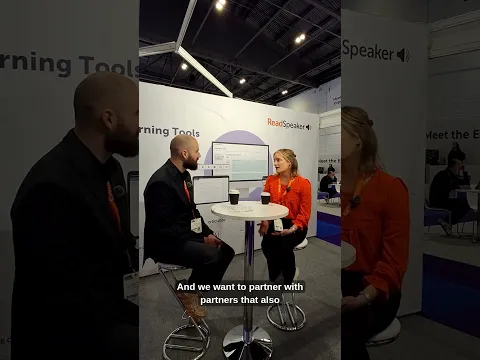
Interview by Hugh McNeela (ReadSpeaker) with Cristina Gilbert, Strategic Partnerships Manager, Cirrus Assessment.
Watch the interview in full
 (play video)
About ReadSpeaker and Cirrus
ReadSpeaker and Cirrus share a common goal: helping organisations deliver digital assessments that are both secure and genuinely accessible. Together, the partnership combines Cirrus’s expertise in high-stakes digital assessment delivery with ReadSpeaker’s long-standing leadership in text-to-speech and accessibility technology.
Cirrus supports awarding bodies, universities, professional certification organisations, and workplace learning providers with secure digital assessment solutions designed for reliability, flexibility, and candidate success. ReadSpeaker provides integrated text-to-speech technology that enables learners to listen to assessment content directly within the exam environment using natural-sounding audio, synchronized highlighting, adjustable reading speeds, and multilingual support.
The partnership is focused on making accessibility part of the assessment experience from the beginning, not something added later as a separate accommodation. By embedding text-to-speech directly into secure assessment environments, organisations can better support learners with dyslexia, visual impairments, ADHD, language barriers, cognitive overload, and other processing challenges while maintaining exam integrity and security.
Together, ReadSpeaker and Cirrus help institutions create more inclusive assessments that measure knowledge and skills more fairly, while also supporting accessibility compliance requirements and improving the overall candidate experience. Find out more about the ReadSpeaker integration with Cirrus.